
Eliminate disconnected systems, improve sales visibility, automate handoffs between sales and operations, and create a seamless flow of data from lead generation to fulfillment.
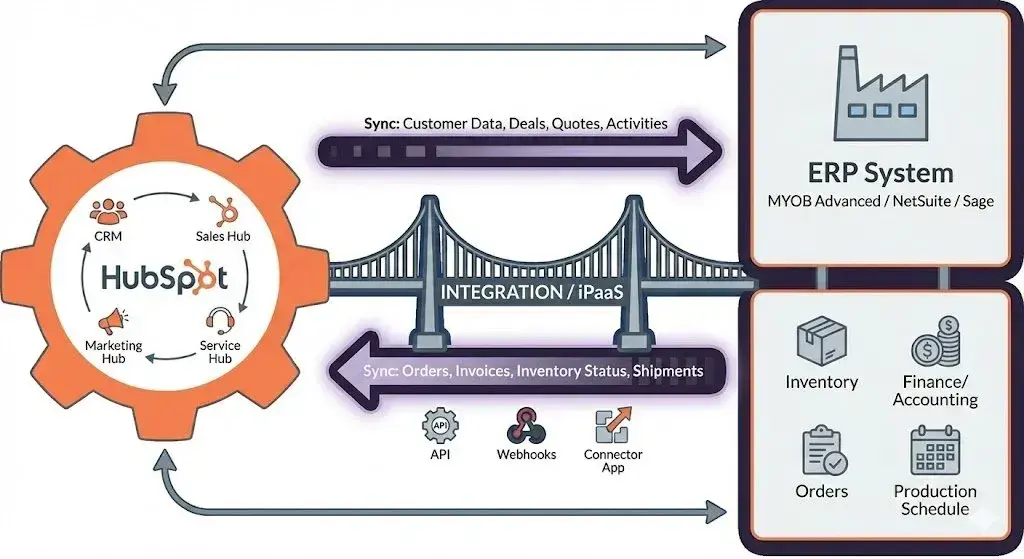
Integration connects these systems so customer, order, and operational data move automatically between both platforms.
Marketing automation, lead nurturing, sales pipelines, quoting workflows, and customer communication.
ERP, inventory management, procurement, production planning, order management, fulfillment, invoicing, and financial reporting.
Manufacturing companies often operate with disconnected systems across sales, operations, finance, and customer support. Integration helps manufacturers create a connected revenue and operations ecosystem.
No more spreadsheets, duplicate customer records, quote inaccuracies, delayed production handoffs, or inconsistent reporting. Integration automates data movement between HubSpot and NetSuite.
Manufacturing Impact
Faster quote-to-order workflows, reduced admin overhead, fewer processing errors, and better production coordination.
When sales data lives only in HubSpot and operational data lives only in NetSuite, forecasting becomes fragmented. Integrated systems provide better demand forecasting, real-time pipeline visibility, and improved inventory planning.
Manufacturing Impact
A shared view of upcoming activity helps reduce overproduction, shortages, and last-minute operational bottlenecks.
Centralize distributor account activity, track partner engagement, sync orders and account status, and improve channel communication and reporting across territories.
Manufacturing Impact
Better visibility into partner relationships and stronger communication between channel sales and operations.
Disconnected systems cause delayed order updates, inaccurate delivery information, and repetitive conversations. Integration delivers faster response times, more accurate quoting, and real-time order visibility.
Manufacturing Impact
Service, sales, and operations access the same customer information, improving responsiveness and retention.
A scalable integration creates a foundation for multi-location operations, expanded product catalogs, higher quote volumes, complex customer relationships, increased automation, and enterprise reporting.
Manufacturing Impact
Your systems become a growth engine instead of an operational bottleneck.
See how a properly designed integration fits your ERP workflows and operational goals.
Schedule a Discovery CallNot every manufacturing company requires the same integration structure. The right approach depends on business complexity, product catalog size, ERP usage, quoting workflows, and reporting needs.
Best for: Manufacturers with straightforward CRM and ERP syncing needs.
What it includes
Advantages
Fast setup, lower implementation cost, easier maintenance, ideal for simple workflows.
Limitations
Limited customization and automation; minimal manufacturing-specific logic; may not support complex ERP workflows.
Best use cases
Smaller manufacturers, standardized sales processes, simple distributor management, basic reporting.
Best for: Manufacturers requiring more flexibility and automation.
Common platforms
What it includes & advantages
Custom workflow automation, advanced data transformation, multi-system integrations, automated error handling. More scalable architecture with better support for manufacturing complexity.
Limitations
Higher implementation complexity, additional platform cost, requires ongoing management.
Best use cases
Multi-location manufacturers, complex quoting workflows, product configuration, distributor ecosystems, multiple ERP integrations.
Best for: Manufacturers with highly customized operational workflows.
What it includes
Advantages
Maximum flexibility, highly tailored workflows, supports advanced manufacturing operations and custom automation.
Limitations
Highest implementation cost, longer timelines, requires technical expertise and ongoing maintenance.
Best use cases
Enterprise manufacturers, custom production environments, complex inventory logic, multi-brand and global operations.
Successful manufacturing integrations require more than connecting two systems. The strategy must align with operational workflows, production processes, reporting requirements, and customer management.
Evaluate current sales workflows, ERP processes, inventory and order management, reporting gaps, data quality, and existing automation.
Key questions: Which system owns customer data? Which controls inventory? How are quotes approved? How are orders transferred to operations? What production data should sales teams access?
One of the biggest causes of integration problems is unclear ownership between systems. A clear structure prevents data conflicts and duplicate records.
HubSpot owns
Marketing activity, lead management, sales pipelines, customer engagement, sales communication, website conversions.
NetSuite owns
Inventory, financials, sales orders, production data, fulfillment, procurement, billing.
Manufacturing integrations often require custom field mapping — SKU numbers, product families, dealer regions, pricing tiers, contract terms, production lead times, warehouse locations, shipping status, customer categories, and PO numbers.
Important: Normalize field formats, remove duplicate values, define required fields, create naming conventions, and document mapping logic.
Determine which records sync, when they sync, which direction data flows, what triggers automation, and how updates are handled.
Workflow examples: Quote-to-order automation (HubSpot deal closes → sales order created in NetSuite → production notified → customer confirmation); inventory visibility surfaced in HubSpot; automatic distributor activity sync.
Manufacturing integrations affect operational workflows, financial processes, and customer communication. Testing should include data accuracy validation, duplicate prevention, workflow automation, quote creation, order syncing, inventory updates, reporting validation, and error handling.
Recommended process: Sandbox testing → limited production rollout → department-level validation → full deployment → ongoing optimization.
A successful integration is not just technical — it requires operational alignment, clean data, and scalable architecture.
Clearly define which system controls specific data. Without ownership rules, records become inconsistent and reporting becomes unreliable. HubSpot = CRM and customer engagement; NetSuite = ERP and operational management.
Remove duplicate records, standardize SKU naming, normalize account structures, clean contact data, and standardize territories. Poor data quality creates syncing errors and operational confusion.
Account for RFQ processes, engineering approvals, production timelines, distributor relationships, inventory availability, multi-stage quoting, and procurement. Build logic around operational reality — not generic CRM workflows.
As volume increases it can impact API limits, sync speed, and reporting. Use batch syncing for large datasets, real-time syncing only where necessary, monitor activity regularly, and build scalable architecture early.
Even well-designed integrations require oversight. Monitor failed syncs, missing records, duplicate creation, API errors, and data mismatches with automated alerts, integration logging, scheduled audits, and monthly optimization reviews.
Serendipity builds integrations around how your business actually operates.
Schedule a Discovery CallManufacturing integrations often involve more complexity than standard CRM implementations. Here are the most common issues — and how we solve them.
Records created separately in HubSpot and NetSuite cause duplicate accounts, fragmented reporting, and inconsistent sales activity.
Our Solution
Data deduplication strategy, matching logic, unique identifier mapping, and ongoing sync governance — for cleaner reporting and more accurate forecasting.
Sales teams quote products that are unavailable or use outdated pricing and SKU information.
Our Solution
Real-time inventory syncing, SKU standardization, product mapping validation, and automated pricing updates — improving quote accuracy and reducing fulfillment issues.
Sales closes deals without operations visibility into timelines, requirements, or customer expectations.
Our Solution
Automated order handoffs, shared operational dashboards, workflow automation between systems, and centralized customer records.
Manufacturers struggle to connect marketing, sales, production, and revenue reporting.
Our Solution
Cross-platform reporting architecture, unified dashboards, revenue attribution setup, and operational KPI integration.
Manufacturers managing dealer or distributor networks often struggle with fragmented account structures and limited visibility.
Our Solution
Custom account hierarchy mapping, partner reporting structures, territory segmentation, and multi-account syncing strategies — for better channel visibility and stronger distributor management.
A properly designed HubSpot + NetSuite integration helps your teams move faster, improve operational accuracy, streamline customer management, and create a scalable foundation for long-term growth.
Schedule a Discovery CallWhat we help manufacturers with
Simple integrations may take a few weeks, while more advanced manufacturing integrations involving custom workflows, distributor management, inventory syncing, or multiple systems can take several months depending on complexity.
Yes. Many manufacturing integrations sync inventory availability, product information, pricing, and SKU data from NetSuite into HubSpot so sales teams can quote more accurately.
Yes. Integrations can support dealer networks, distributor account structures, territory management, and partner-specific reporting workflows.
No. HubSpot and NetSuite serve different purposes. HubSpot manages marketing, sales, and customer engagement; NetSuite manages ERP functions such as inventory, operations, production, procurement, fulfillment, and financials. The integration allows both systems to work together.
Common synced data includes customers and contacts, quotes and sales orders, products and SKUs, inventory availability, pricing, shipment status, deal activity, customer lifecycle data, payment status, and distributor account data.
Not always. Many manufacturers use a hybrid strategy where critical workflows sync in real-time while large datasets sync in scheduled batches to improve performance and reduce API strain.
Yes. Middleware or custom API integrations can support advanced manufacturing workflows including RFQ automation, custom quoting, production approvals, multi-stage order processing, complex account structures, and engineering workflows.
The biggest challenge is usually operational alignment. Most integration problems stem from unclear data ownership, inconsistent workflows, duplicate records, or poor data quality — not the technology itself.
Create a connected system that improves visibility across sales, operations, production, and customer management. Let's build a scalable manufacturing integration strategy.
Book Your Integration ConsultationTalk with a manufacturing-focused HubSpot integration team about your ERP workflows, operational goals, and system architecture.